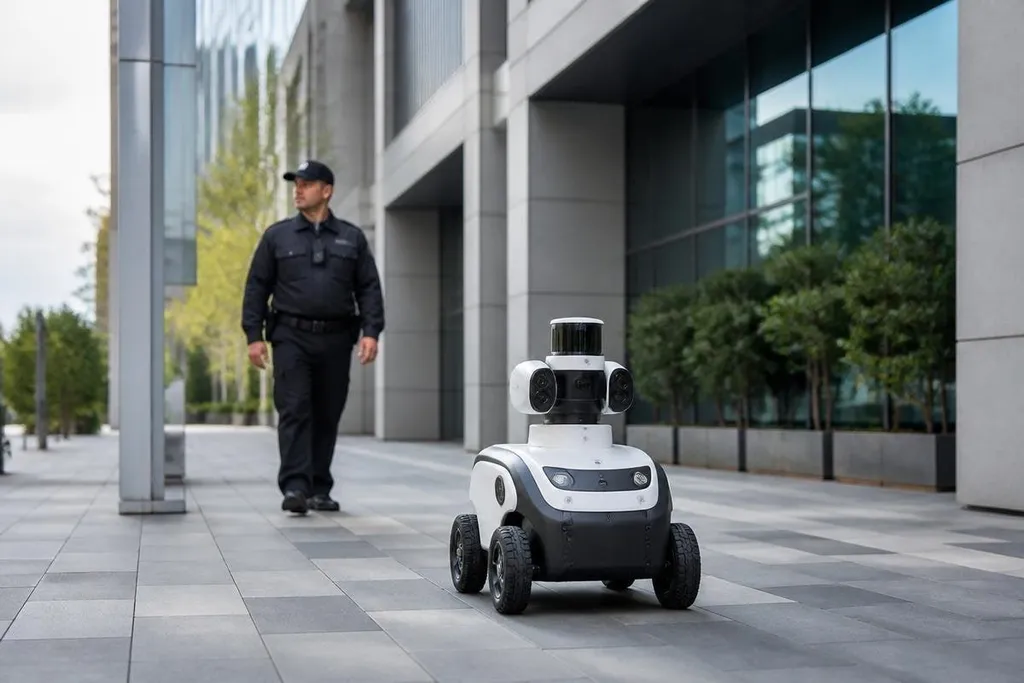
A security robot has to do more than move through a site with cameras running. It must spot a real problem, explain what it found, and give a person enough evidence to act.
For a site manager comparing patrol robots, the hard question is simple: does the machine reduce missed events without creating a new stream of false alarms?
- Useful patrols need context: location, time, image data, and the reason for each alert.
- Human review stays in the loop: a remote operator may need to confirm what the robot found.
- The weak point is often outside the robot: poor lighting, blocked routes, and weak network links can stop a patrol.
What a security robot must detect
Most security robots combine several sensors because one camera cannot cover every condition. A visible-light camera records people, vehicles, doors, and other objects. A thermal camera can show heat when darkness or low light limits the normal image.
LiDAR measures distance by sending out laser pulses and reading their return. That lets a ground robot build a map, avoid fixed objects, and check whether a route has changed. The robot still needs software that can tell a parked pallet from a person who has fallen.
This is where many patrol claims become hard to judge. A video can show a robot moving through an empty site, yet say little about how it handles rain, glare, smoke, crowded walkways, or a blocked charging station.
A useful test asks what the robot records after an alert. The file should connect the event to a time, position, sensor view, and action taken. Without that chain, the robot may spot something while leaving the guard to reconstruct the event from separate systems.
Why response work stays human
Security robots can patrol set routes and send alerts across a large site. They cannot make every decision safely from a camera feed. A person may need to check an open gate, a damaged fence, or a worker lying on the floor before anyone is sent to the area.
Remote control is one answer. A trained operator can take over the robot, change its route, or move the camera closer to an object. That creates a second requirement: the control link must keep working when walls, distance, or network traffic weaken the signal.
The handoff also needs a record. A useful log shows when the robot raised the alert, when a person reviewed it, and what happened next. This matters during an incident review, when a site manager needs facts rather than a vague statement that the patrol system was active.
A security robot's value shows up in the record around each alert: the sensor used, patrol area, operator response, and date. Reports from Robot24.com can put those details beside claims about named machines and field tests before the next section checks the limits buyers should test.
The limits buyers should test
A security robot has to work inside the site where it will run. A warehouse with narrow aisles needs a different body and route plan from an outdoor yard with loose ground.
A hospital adds privacy rules, people moving close to the robot, and doors that may not stay open. Battery charging can also shape the patrol plan.
If the robot must leave its route for charging, the area left without coverage needs a clear handoff. A site manager should ask whether the robot can return to the same point, report a failed charge, and keep a record of the missed route.
Cybersecurity belongs in the same review. Cameras, maps, remote controls, and alarm logs all create access points. Buyers need to know who can view the data, how long records stay stored, and how the operator account is protected.
I’d choose a slower robot with clear alarm records over a faster patrol robot that cannot show why it stopped.
A buying checklist for the site
Use these checks before a trial becomes a purchase:
- Map the route: mark doors, lifts, slopes, charging points, and places where people gather.
- Test bad conditions: run the patrol in darkness, rain, glare, and a weak network area.
- Check the alert record: confirm that each event includes time, position, images, and operator action.
- Review the handoff: ask who responds after an alarm and how the robot returns to patrol.
- Set data rules: define access, storage time, deletion, and software update duties.
A trial should end with a written list of missed events, false alarms, charging gaps, and operator actions. That record will tell you more than a polished demonstration, and it gives the next buying decision a number to beat.